
Role of Authorities under FRA (Section 6)
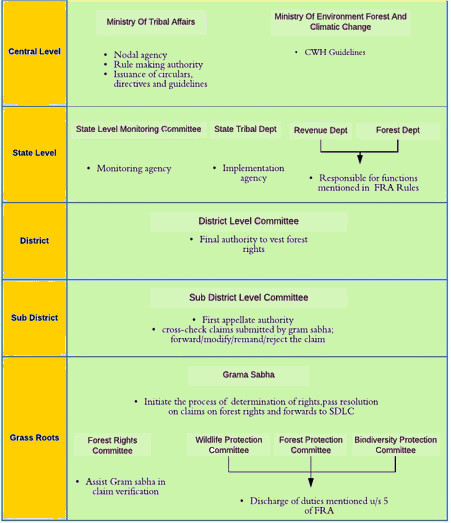
Gram Sabha:
Gram Sabha is the authority to initiate the process for determining the nature and extent of individual or community forest rights or both that may be given to the forest dwelling Scheduled Tribes and other traditional forest dwellers within the local limits of its jurisdiction under this Act by receiving claims, consolidating Gram Sabha As per section 2 (g) of the Forest Rights Act “Gram Sabha” means a village assembly which shall consist of all adult members of a village and in case of States having no panchayats, padas, tolas and other traditional village institutions and elected village committees, with full and unrestricted participation of women. • The Gram Sabhas are to be convened by the Gram Panchayat and verifying them and preparing a map delineating the area of each recommended claim in such manner as may be prescribed for exercise of such rights and the Gram Sabha shall, then, pass a resolution to that effect and thereafter forward a copy of the same to the Sub-Divisional Level Committee.
Functions of the Gram Sabha:
- Elect from amongst its members, a committee of not less than ten but not exceeding fifteen persons as members of the Forest Rights Committee.
- Initiate the process of determining the nature and extent of forest rights, receive and hear the claims relating thereto.
- Specifically the Gram Sabha has to,
- Call for claims and authorize the Forest Rights Committee to accept the claims which should be made within a period of three months from the date of such calling of claims along with at least two of the evidences.
- Extend, if consider necessary, the period of three months for submission of claims after recording the reasons thereof in writing.
- Fix a date for initiating the process of determination of its community forest resource and intimate the same to the adjoining Gram Sabhas where there are substantial overlaps, and the SubDivisional Level Committee.
- Ask for necessary information, records or documents from the government authorities.
- Prepare a list of claimants of forests rights and maintain a register containing such details of claimants and their claims.
- Consider findings of the verification made by the FRC and to pass appropriate resolutions on claims on forest rights after giving reasonable opportunity to interested persons and authorities concerned and forward the same to the Sub-Divisional Level Committee.
-
Ensure resolution of conflicting claims in respect of the traditional or customary boundaries of another village or if a forest area is used by more than one Gram Sabha. For this the Forest Rights Committees of the respective Gram Sabhas are to call a joint meeting to consider the nature of enjoyment of such claims and submit the findings to the respective Gram Sabhas in writing. If the Gram Sabhas are not able to resolve the conflicting claims, then it should be referred by the Gram Sabha to the Sub-Divisional Level Committee for its resolution.
Forest Rights Committee
The Forest Rights Committee consists of ten to fifteen members elected by the Gram Sabha in its first meeting. The FRC is required to have
- . At least one-third members who should be the Scheduled Tribes:
- Not less than one-third of such members should be women:
- Provided further that where there are no Scheduled Tribes, at least one third of such members should be women.
Functions of the Forest Rights Committee:
- Receive, acknowledge and retain the claims in the specified form and evidence in support of such claims;
- Prepare the record of claims and evidence including maps;
- Prepare a list of claimants on forest rights;
- Verify claims as provided in these rules;
- Present their findings on the nature and extent of the claim before the Gram Sabha for its consideration.
Sub-Divisional Level Committee
The Sub-Divisional Level Committee is constituted by the State government with the following members:
- Sub-Divisional Officer or equivalent officer - Chairperson;
- Forest Officer in charge of a Subdivision or equivalent officer - member;
- Three members of the Block or Tehsil level Panchayats to be nominated by the District Panchayat of whom at least two shall be the Scheduled Tribes preferably those who are forest dwellers, or who belong to the primitive tribal groups and where there are no Scheduled Tribes, two members who are preferably other traditional forest dwellers, and one shall be a woman member; or in areas covered under the Sixth Schedule to the Constitution, three members nominated by the Autonomous District Council or Regional Council or other appropriate zonal level, of whom at least one shall be a woman member;
- An officer of the Tribal Welfare Department in-charge of the Subdivision or where such officer is not available the officer in-charge of the tribal affairs.
Functions of the Sub-Divisional Level Committee:
- Raise awareness among forest dwellers about the objectives and procedures laid down under the Act and in the rules ;
- Provide such information and records as has been asked by the Gram Sabha or the FRC and to facilitate clarification of the same through an authorized officer, if required.
- Provide forest and revenue maps and electoral rolls to the Gram Sabha or the Forest Rights Committee;
- Ensure that the Gram Sabha meetings are conducted in free, open and fair manner with requisite quorum.
- Ensure easy and free availability of proforma of claims to the claimants.
- Collate all the resolutions of the concerned Gram Sabhas;
- Consolidate maps and details provided by the Gram Sabhas;
- Examine the resolutions and the maps of the Gram Sabhas to ascertain the veracity of the claims;
- Hear and adjudicate disputes between Gram Sabhas on the nature and extent of any forest rights;
- Co-ordinate with other SubDivisional Level Committees for inter subdivisional claims ;
- Prepare block or tehsil-wise draft record of proposed forest rights after reconciliation of government records;
- Forward the claims with the draft record of proposed forest rights through the Sub-Divisional Officer to the District Level Committee for final decision;
District Level Committee:
The District Level Committee is constituted by the State Government with the following members:
- District Collector or Deputy Commissioner - Chairperson;
- Concerned Divisional Forest Officer or concerned Deputy Conservator of Forest - member;
- Three members of the district panchayat to be nominated by the district panchayat, of whom at least two shall be the Scheduled Tribes preferably those who are forest dwellers, or who belong to members of the primitive tribal groups, and where there are no Scheduled Tribes, two members who are preferably other traditional forest dwellers, and one shall be a woman member; or in areas covered under the Sixth Schedule to the Constitution, three members nominated by the Autonomous District Council or Regional Council of whom at least one shall be a woman member;
- An officer of the Tribal Welfare Department in-charge of the district or where such officer is not available, the officer in charge of the tribal affairs
Functions of District Level Committee:
- Ensure that the requisite information under clause (b) of rule 6 has been provided to Gram Sabha or Forest Rights Committee;
- Examine whether all claims, especially those of primitive tribal groups, pastoralists and nomadic tribes, have been addressed keeping in mind the objectives of the Act;
- Consider and finally approve the claims and record of forest rights prepared by the Sub-Divisional Level Committee;
- Co-ordinate with other districts regarding inter-district claims;
- Issue directions for incorporation of the forest rights in the relevant government records including record of rights;
- Ensure publication of the record of forest rights as may be finalized;
- Ensure that a certified copy of the record of forest rights and title under the Act, as specified in Annexures II and III to these rules, is provided to the concerned claimant and the Gram Sabha respectively.
State Level Monitoring Committee:
The State Level Monitoring Committee is constituted by the State Level Monitoring Committee with the following members,
- Chief Secretary - Chairperson;
- Secretary, Revenue Department - member;
- Secretary, Tribal or Social Welfare Department - member;
- Secretary, Forest Department - member;
- Secretary, Panchayati Raj - member;
- Principal Chief Conservator of Forests - member;
- Three Scheduled Tribes member of the Tribes Advisory Council, to be nominated by the Chairperson of the Tribes Advisory Council and where there is no Tribes Advisory Council, three Scheduled Tribes members to be nominated by the State Government;
- Commissioner, Tribal Welfare or equivalent who shall be the Member Secretary.
Functions of the State Level Monitoring Committee:
- Devise criteria and indicators for monitoring the process of recognition and vesting of forest rights;
- Monitor the process of recognition, verification and vesting of forest rights in the State;
- Furnish a six monthly report on the process of recognition, verification and vesting of forest rights and submit to the nodal agency.
Grievance and Appeal
Any person aggrieved by the decision of the authorities regarding recognition of rights can appeal at the higher authorities and the authorities are required to hear and dispose such petitions.
Gram Sabha, in case of reference by the SDLC on any appeal against the resolution passed by it, is required to meet within a period of thirty days, hear the petitioner, pass a resolution on that reference and forward the same to the Sub-Divisional Level Committee.
SDLC, in case of an appeal by any claimant against the resolution of the Gram Sabha, is required to consider and dispose of the petition as per the procedure laid down in Rule 14. The SDLC has to ensure that no such petition is disposed of against the aggrieved person, unless he has been given a reasonable opportunity to present his case.
DLC, in case of an appeal by persons aggrieved by the orders of the SDLC, is required to consider and dispose of such petitions as per the procedure laid down in Rule 15. The DLC has to ensure that no such petition is disposed against the aggrieved person unless he has been given a reasonable opportunity to present his case.